
Financial terms such as EBITDA, ROIC, sales, TSR, and exceptional items can often feel confusing or overwhelming. Yet, they are essential for understanding how a business is performing, how it compares to competitors, and where it is headed.
In this series, we break down key financial concepts through the journey of Shaï, a passionate young entrepreneur learning to master the financial side of her business.
- What Is EBITDA?
EBITDA stands for Earnings Before Interest, Taxes, Depreciation, and Amortization.
It measures how much money a company makes from its core operations before accounting for financial costs, taxes, or the gradual loss of value in equipment and intangible assets.
In other words, EBITDA helps us understand the true profitability of day-to-day operations.
- How Do You Calculate EBITDA?
To calculate EBITDA, we start with revenue (sales) and adjust it:
EBITDA = Net Income + Interest + Taxes + Depreciation + Amortization
- Why Is EBITDA Useful?
- Stability: By excluding taxes, financing, and non-cash charges, EBITDA is more stable than net profit.
- Comparison: It allows comparisons between companies across countries, since it neutralizes differences in tax systems or financing.
- Profitability insight: It shows whether the business model is profitable on its own, regardless of external factors.
A key metric is the EBITDA margin = (EBITDA ÷ Revenue) × 100.
It indicates what percentage of sales is left after covering operating costs.
Shaï’s Example
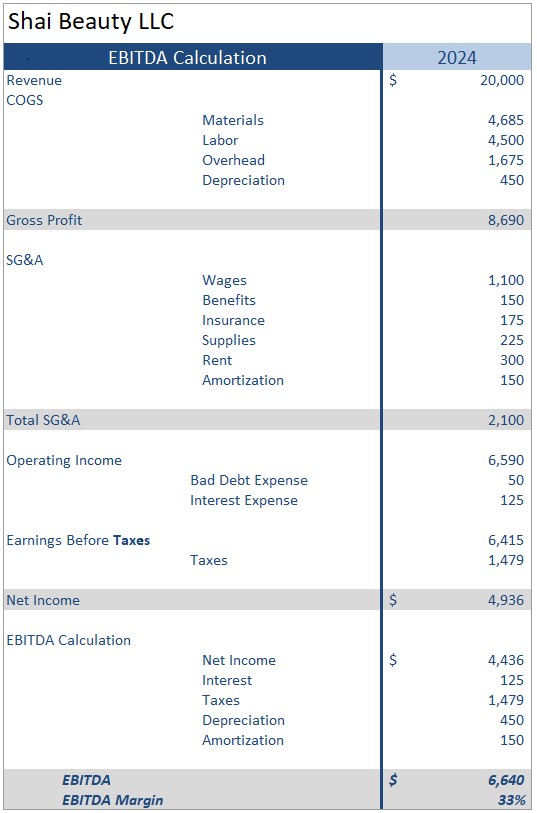
Shaï runs her natural cosmetics business and wants to know how profitable her operations are.
So, Shaï learns that her core business activities generate a 33% operating margin, independent of financing or tax considerations.
EBITDA is more than just a financial acronym. It gives entrepreneurs like Shaï a clearer picture of operational profitability, stripped of external or accounting effects.
In the next article, Shaï will dive into another essential financial concept to keep building her toolkit for business success.